The Repair Spectrum Nobody Explains
Paint damage repair is not a two-option choice between a $30 pen and a $900 respray — it is a five-step spectrum, and most drivers only ever hear about the ends. From cheapest to dearest: touch-up for chips, polishing for clear-coat scratches, wet-sand-and-polish for deeper marks that have not reached color, spot repair (also called smart repair) for localized damage, and full panel refinishing with blending. Each step exists because paint is a layered system — primer, color base, clear coat — and the correct repair depends entirely on which layer the damage reached. The fingernail test sorts most cases in five seconds: a scratch your nail glides over lives in the clear coat and can likely be polished; one your nail catches has reached base or primer and needs material added, not removed.
What Touch-Up Genuinely Fixes
Touch-up paint has exactly one honest job: sealing small chips against rust. A factory-matched pen or bottle, dabbed — never brushed — into a stone chip, then leveled and sealed, stops moisture from reaching bare metal and blends to invisible-at-arm's-length on non-metallic colors. That is a real and valuable repair worth doing the week the chip appears, especially on hoods and rocker panels that catch road spray. What touch-up does not do is fix scratches: dragged along a scratch line, touch-up paint reads as a colored scar more visible than the original damage, which is how most DIY paint regret is manufactured. Rule of thumb: touch-up for damage smaller than a pencil eraser, and one dab per chip.
Buy paint by your car's paint code — on the door-jamb sticker, not by eyeballing color names — and expect $15 to $40 for a factory-match pen with clear coat. Thirty minutes of careful work protects hundreds of dollars of panel.

The Middle Options Shops Rarely Volunteer
Between the pen and the booth sit two repairs worth asking for by name. Machine polishing and wet-sanding remove a thin layer of clear coat to erase scratches that never reached color — $75 to $250 per panel at a detailer, and the correct fix for the swirl marks, light key scratches, and buffed-in scuffs that make up half of all paint complaints. Spot repair goes one step further: a technician refinishes only the damaged few square inches, blending clear coat into the surrounding panel — $150 to $450, mobile services often included, and ideal for bumper scuffs and door-edge damage where a full-panel respray would be overkill. Shops oriented around collision work often skip mentioning both because their booth is built for whole panels; asking “is this a candidate for spot repair or polishing?” signals you know the spectrum exists and frequently shrinks the quote by half.
When a Respray Is the Honest Answer
Three conditions make full panel refinishing the right call rather than the expensive one. Damage through the base coat over an area larger than a few inches — spot repairs larger than that stop blending convincingly. Clear coat failure — the cloudy, peeling patches on sun-baked hoods and roofs cannot be polished because the failed layer must be removed and replaced entirely. And previous bad repairs — mismatched or orange-peeled earlier work usually cannot be corrected except by doing the panel properly. A quality single-panel respray with blending runs $450 to $1,000 depending on color complexity, and on metallics and pearls the blending into adjacent panels is not an upsell; it is the difference between a repair and a visible patch, as our dent cost guide explains from the dent side of the same jobs.
Why Color Match Is Harder Than It Looks
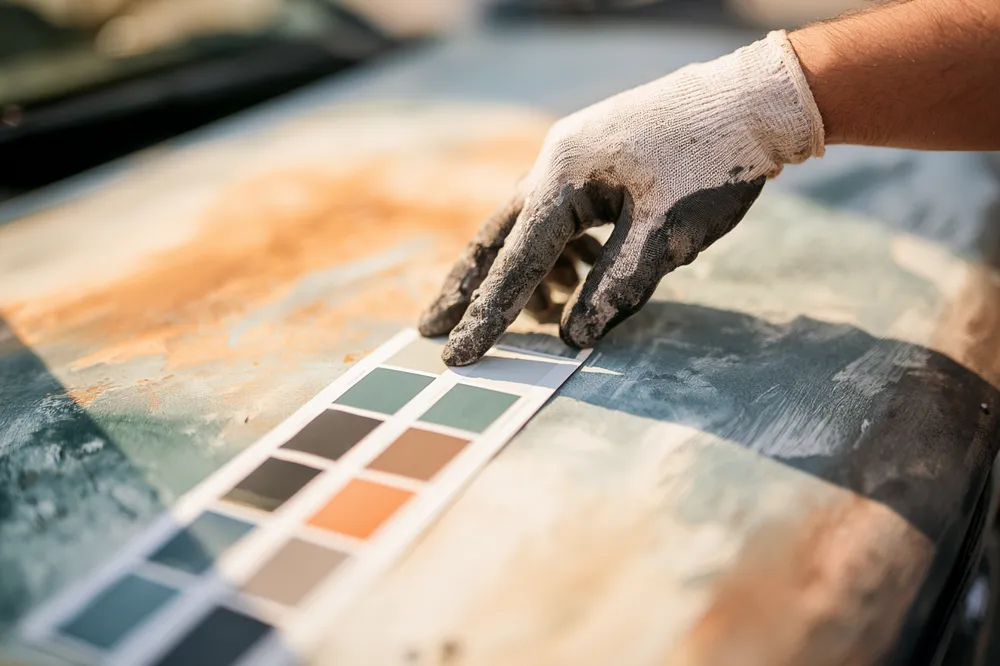
Your car's “white” is not a color; it is a formula — and a formula that no longer matches your car. Factory paint fades unevenly over years of sun, so a panel mixed to the original code will sit visibly brighter beside its neighbors. Professional shops solve this with a spectrophotometer reading of your actual faded paint, a custom-tinted mix, and sprayed test cards checked under multiple light sources before the gun touches the car. This is the machinery and skill you are buying when a respray quote seems high, and it is why rattle-can repairs photograph fine and look wrong in person: the human eye detects a 5% color shift across a panel gap instantly. When comparing quotes, ask whether the price includes a camera match and blend — the cheap quote that skips both is not the same product at a lower price; it is a different, worse product.
Costs Across the Spectrum
| Repair | Fixes | Typical Range |
|---|---|---|
| Touch-up pen (DIY) | Stone chips to bare metal | $15 – $40 materials |
| Machine polish / wet-sand | Clear-coat scratches, swirls | $75 – $250 per panel |
| Spot (smart) repair | Localized base-coat damage | $150 – $450 |
| Single panel respray with blend | Large or through-paint damage | $450 – $1,000 |
| Multi-panel respray | Faded clear, previous bad work | $1,200 – $3,500 |
| Full vehicle respray, quality tier | Whole-car restoration | $3,500 – $8,000+ |
A Decision Framework
Work the spectrum from cheap to dear and stop at the first repair that honestly fits. Nail glides over it: polish. Nail catches but color is intact underneath: wet-sand and polish. Color breached, damage smaller than a hand: spot repair quote first, panel quote second, compare. Damage larger, clear coat failing, or a previous repair gone wrong: panel respray with blending, from a shop that camera-matches. And at every step, the rust clock overrides aesthetics — exposed metal gets sealed this week with a $20 pen even if the proper repair waits for next quarter's budget. That sequencing, cheap-and-now before perfect-and-later, is the single habit that keeps paint spending rational.
Funding the Bigger Jobs
The spectrum's top tiers are where payment planning enters. Polishing and spot repairs are debit-card territory; multi-panel resprays at $1,200 to $3,500 are precisely the band where fixed-payment financing beats both draining an emergency fund and parking the bill on a 27% credit card. A personal loan sized to the written estimate — the model described on our auto body and paint loans page — converts the job into a predictable monthly figure you can preview in the calculator, and road loans in this range commonly fund the day after approval, fast enough to catch a body shop's slow-season pricing. Whichever way you pay, pay for the version with the camera match and the blend; financing the cheap patch twice costs more than financing the right repair once.
Budgeting the Spectrum: What to Pay Cash For and What to Finance
The five-step spectrum maps neatly onto payment methods, and matching them keeps paint spending rational at every tier. Steps one through three — touch-up materials, polishing, and spot repairs, spanning $15 to $450 — belong to cash and the monthly budget; financing amounts this small costs more in friction than it saves in timing. Step four, the single-panel respray at $450–$1,000, sits at the boundary: fund it from savings when the account survives the hit, and from a short personal loan when it does not, because the alternative of waiting usually means watching the damage cross the rust line into a bigger tier. Step five — multi-panel work at $1,200–$3,500 — is the tier road loans were effectively sized for: real four-figure bills, fixed 18–36 month schedules, and totals a written estimate can pin down before any road loan application gets submitted.
One spectrum-specific financing note: paint work rewards the patient buyer, and personal loans make patience affordable. Because a funded borrower can book the shop's slow season and pay as a cash customer, the loan route frequently captures both an off-peak quote and a paid-in-full discount — savings that offset a meaningful share of the interest. The road lending network's next-business-day funding also means a spotted rust bloom can be sealed and scheduled inside a week, which matters because rust is the one clock on this page that never pauses for budgeting. Whatever tier you land on, decide with the calculator open and the estimate in hand: paint regret comes from financing guesses and cash-flowing emergencies, and both are avoidable with ten minutes of arithmetic.
Bottom Line
Paint repair is a ladder, and money is saved by stopping on the correct rung: polish what the nail glides over, spot-repair what stays smaller than a hand, and respray only what genuinely crossed the base coat — with the camera match and blend that make resprays worth their price. Chips get sealed this week at any budget, because rust ignores financing plans entirely. When the job lands on the upper rungs, personal loans fit the shape: defined totals, 18–36 month terms, and road loans funding fast enough to catch off-season booth pricing. The one universal rule across every rung — cash tier or personal loan tier — is deciding with the estimate written and the arithmetic open, since paint regret is almost always a financed guess or a cash-flowed emergency, and road loans sized to real quotes produce neither.
Reader question worth appending: how long should each rung of the spectrum last? Honest service lives: touch-up seals hold years if the dab cured properly; polished clear coat lasts until the next scratch; spot repairs run five-plus years before edges may show; and a quality panel respray outlives most ownership periods. Those lifespans are also the financing sanity check — a personal loan term should sit comfortably inside the repair's life, and every rung above clears a 24-month personal loan easily. The reverse check works too: if a quoted repair cannot outlast the shortest personal loan on the menu, buy a better repair, not a longer personal loan. When a cheap quote cannot promise those lifespans in writing, the discount is borrowed time, which is the one loan this page recommends against.
Keep Reading
What Car Dent Repair Really Costs
The four variables that make identical dents price ten times apart.
Auto Body & Paint Loans
Financing paint and body work from $500 to $5,000 with fixed payments.